
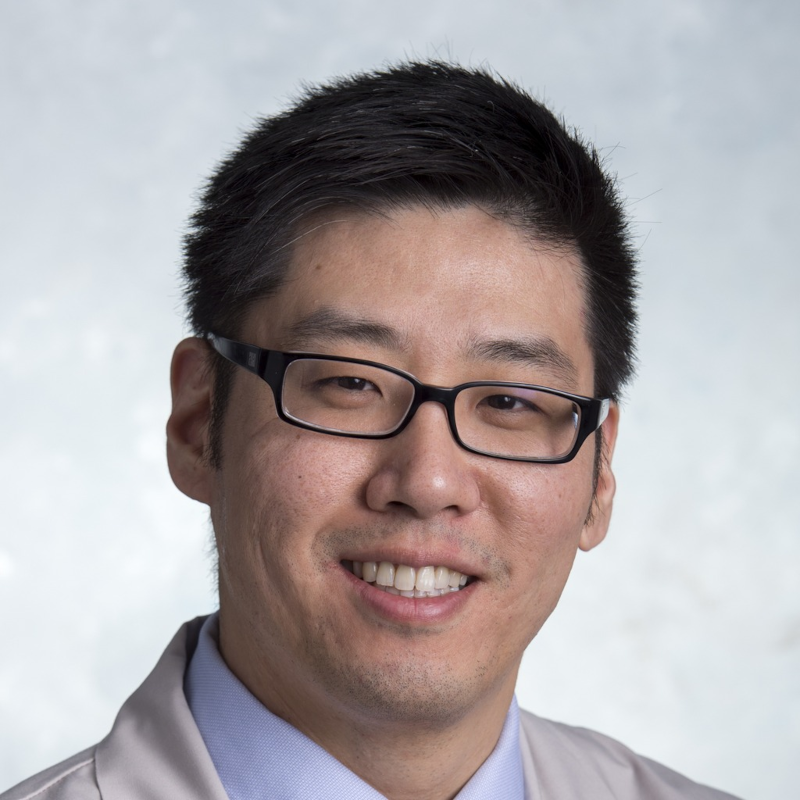
Paul Chung, DO
2024 Toffler Scholar | Physician–Scientist in Sleep Medicine, Northwestern University
Biography
Paul Chung did not follow a straight line into medicine. His path unfolded through curiosity, detours, and a steady pull toward understanding people in context. Born in Atlanta and raised in Chicago, Chung grew up immersed in community, movement, and music. He played nearly every sport available to him, from basketball and soccer to hockey and football, often outdoors and unscheduled. Through his church, he also found music, learning cello early and later adding trombone.
“I just wanted to be outside,” he laughs. “Studying was never my instinct.”
Yet medicine lingered quietly in the background. Chung’s mother worked as a nurse, and he occasionally accompanied her to work, absorbing the rhythms of clinical care. Within his church community, several figures he admired were physicians. One pediatrician in particular left a lasting impression, not just for technical skill, but also for joy, kindness, and attentiveness.
“I didn’t know exactly what doctors did,” Chung recalls, “but I knew I respected the way they showed up for people.”
Biography
Paul Chung did not follow a straight line into medicine. His path unfolded through curiosity, detours, and a steady pull toward understanding people in context. Born in Atlanta and raised in Chicago, Chung grew up immersed in community, movement, and music. He played nearly every sport available to him, from basketball and soccer to hockey and football, often outdoors and unscheduled. Through his church, he also found music, learning cello early and later adding trombone.
“I just wanted to be outside,” he laughs. “Studying was never my instinct.”
Yet medicine lingered quietly in the background. Chung’s mother worked as a nurse, and he occasionally accompanied her to work, absorbing the rhythms of clinical care. Within his church community, several figures he admired were physicians. One pediatrician in particular left a lasting impression, not just for technical skill, but also for joy, kindness, and attentiveness.
“I didn’t know exactly what doctors did,” Chung recalls, “but I knew I respected the way they showed up for people.”
Research Focus
When Chung arrived at Northwestern University, he followed a different passion. He majored in history, drawn in part by family dinner-table conversations led by a father who loved historical narratives. What began as reluctant listening became genuine fascination. Two professors, one in Chinese history and another in Islamic history, reshaped how Chung thought about the world. Their courses sparked a deep interest in culture, context, and continuity.
He spent extended time studying abroad in China, an experience that further expanded his worldview. Only later did he recognize how profoundly this training would shape his medical career.
“Doctors are historians,” Chung reflects. “You listen to someone’s story, their past, their culture, their environment. Research is the same way. You can’t move forward without understanding what came before.”
Despite the richness of his undergraduate education, Chung faced a practical question after graduation. He still wanted to become a physician, but his transcript lacked the necessary science coursework. He took a nontraditional route, enrolling in a master’s program at Loyola University Chicago to complete his prerequisites, then moving on to medical school.
Medical training clarified everything.
“I found my passion there,” he says. “Understanding physiology, caring for patients, and trying to help them make sense of what was happening to their bodies felt deeply right.”
Chung trained in internal medicine and later pulmonary and critical care, immersing himself in complex physiology and high-acuity environments. He served as chief resident, drawn to education and leadership. At the same time, he began to recognize the limits of clinical care alone.
“As physicians, we can only do so much at the bedside,” he explains. “Research is how we expand that impact.”
“Doctors are historians. You listen to someone’s story, their past, their culture, their environment. Research is the same way. You can’t move forward without understanding what came before.”
– Paul Chung, MD, PhD
Sleep medicine emerged as a turning point. Initially interested in advanced lung disease and transplantation, Chung shifted focus after encountering puzzling clinical observations. In one early study, patients exposed to white noise reported dramatically improved sleep quality, even when objective sleep metrics showed little change.
“That contradiction fascinated me,” Chung says. “Something was happening that we weren’t measuring.”
The experience redirected his career. Chung trained in sleep medicine and began to focus on the neurophysiology of sleep, not just airway obstruction or breathing patterns, but how brain activity during sleep shapes cognition, memory, and long-term brain health.
The COVID-19 pandemic further sharpened his resolve. While working long hours in the ICU caring for critically ill patients, Chung contracted COVID himself. The illness was severe enough to force him into isolation and deep reflection.
“That was a moment of reckoning,” he says. “I had seen people die. I knew how fragile things could be.”
During recovery, conversations with his wife, a dentist and PhD-trained scientist, pushed him to think more deliberately about impact.
“She challenged me to ask what kind of research truly helps people,” Chung says.
That question found its answer through an unexpected encounter. At a research forum, Chung learned about the profound research gaps affecting individuals with Down syndrome. Despite being the most common chromosomal condition in the United States, researchers have historically excluded people with Down syndrome from many clinical trials. At the same time, they face an extraordinarily high risk of early-onset Alzheimer’s disease.
“That stayed with me,” Chung says. “It felt like a place where research could make a real difference.”
Chung’s research now centers on the neurophysiology of sleep and circadian rhythms in individuals with Down syndrome. Because chromosome 21 carries the gene for amyloid precursor protein, people with Down syndrome overproduce amyloid beta and face a near-universal risk of Alzheimer’s disease. Yet the age of onset varies widely, suggesting that modifiable factors may influence disease trajectory.
Sleep appears to be one of them.
Using advanced EEG analysis, Chung studies sleep oscillations, brain rhythms that support memory consolidation, and neural circuit maintenance. Traditional sleep studies rely heavily on visual staging. Still, Chung applies computational methods to extract far more granular information from EEG data. These sleep biomarkers may reveal early signs of cognitive vulnerability long before symptoms emerge.
His work focuses on late adolescence and early adulthood, a critical window that remains understudied. By linking sleep EEG biomarkers with cognitive testing, Chung aims to identify early signals of neurodegeneration and, eventually, develop targeted interventions.
In 2024, Chung received a Toffler Scholar Award, which marked a pivotal moment in his career. The funding accelerated his research timeline, enabled acquisition of reusable EEG headband technology, and supported pilot studies that would otherwise have remained out of reach.
“This was the moment I felt like I was becoming a researcher, not just doing research,” he says.
Beyond resources, Chung values the validation.
“Receiving the Toffler Scholar Award made me feel that my work mattered,” he says. “It validated the idea that these questions are worth asking.”
Looking ahead, Chung envisions a future where sleep-based interventions improve quality of life across populations, not only for individuals with Down syndrome, but for anyone at risk of cognitive decline. He believes collaboration will drive progress and sees research as a long game that demands patience and perspective.
For Chung, medicine, history, and research remain deeply intertwined.
“If we want to help people,” he says, “we have to understand their stories first.”