
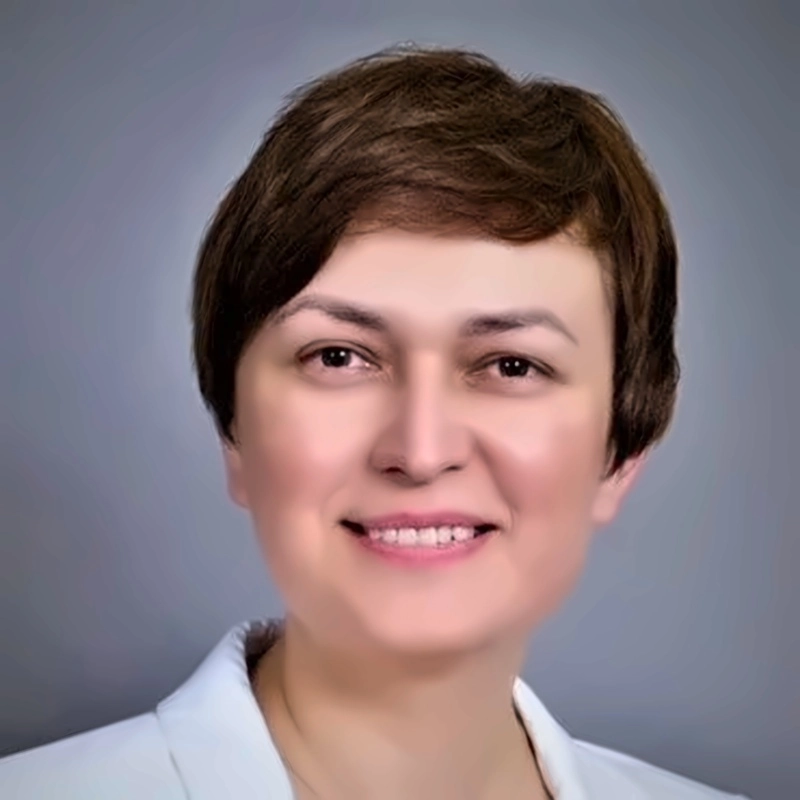
Tetyana Buzhdygan
2024 Toffler Scholar from Temple University
Tetyana's Mission : Unlocking the Blood-Brain Barrier in Alzheimer's Disease
Tetyana Buzhdygan, PhD
Institution : Temple University
Research Focus : Investigating the role of estrogen and blood-brain barrier integrity in Alzheimer's disease using dynamic in vitro models and molecular assays. Tetyana's research is significant as it could potentially lead to the development of new treatments or preventive measures for Alzheimer's disease, a condition that disproportionately affects women.
Toffler Scholar Since: 2023
A Childhood Spark in Ukraine
Tetyana grew up in Ukraine, where a childhood fascination with books and the invisible world of atoms sparked her early dream of becoming a molecular biologist. Captivated by the idea that unseen particles built the visible world, she set sights on science at age five.
Navigating Ukraine's Educational System
Tetyana's path through Ukraine's rigorous educational structure taught her discipline and depth. At her alma mater in Ukraine, she followed comprehensive biology curriculum that gave her a solid grounding in scientific fundamentals. While pursuing her molecular biology degree, Tetyana became fascinated with psychology and to combine both fields, she crossed continents to pursue graduate degree in Neuroscience at the University of Texas Medical Branch. There, she united her passions, delving into the neurobiological intersections of molecular biology and psychology.
A Professional and Personal Partnership
After earning her PhD, Tetyana joined Temple University to investigate how inflammation from viral infections like HIV and COVID, combined with drug use, damages the blood-brain barrier (BBB). She later turned her focus to Alzheimer's disease, where she discovered that many of the same inflammatory signals are triggered by amyloid beta and similarly contribute to BBB breakdown. This turn deepened her interest in understanding how chronic inflammation accelerates neurodegeneration by impairing the brain’s protective barrier.
Blood-Brain Barrier as a Lifelong Focus
Throughout her career, Tetyana has remained fascinated by the blood-brain barrier (BBB), the brain's dynamic shield. Currently, she examines how the hormonal changes in aging women worsen negative effects of inflammation and amyloid on the BBB protective capabilities.
Her approach is distinct and meticulous. She recreates physiological blood flow over endothelial cells using advanced microfluidic platforms, mimicking the shear stress found in real capillaries. She then adds another layer of complexity—hypoxia chambers, Matrigel matrices with embedded amyloid beta, and dynamic co-cultures with immune cells—to model BBB breakdown as disease progresses. These tools and methods allow her to simulate the complex environment of the human brain capillary in her lab.
A Pioneer in Precision and Complexity
What sets Tetyana's work apart is her determination to recreate real-world biology in the lab. Too many studies, she explains, rely on static models that fail to replicate the actual environment of the human brain vasculature. She aims to establish reproducible, physiologically relevant assays offering real insights into BBB injury in Alzheimer's disease.
Karen Toffler Charitable Trust Funding: A Catalyst for Independent Discovery
With support from the Toffler Charitable Trust, Tetyana has been able to pursue bold questions outside the scope of existing funding. She used her Toffler Scholar funding to study the effects of estrogen on BBB function in Dr. Silvia Fossati's lab and Alzheimer’s Center at Temple. Her current work is laying the foundation for a larger NIH grant proposal.
She's now analyzing whether estradiol can protect BBB from amyloid-induced damage. Her aim is ambitious yet vital: identifying a treatment that offers cognitive protection without raising cancer risk often associated with use of estrogen replacement therapy.
Looking Ahead: From Cells to Clinical Application
Tetyana's research is already expanding. She plans to transition from in vitro to in vivo studies, testing how her findings translate to the next level of biological complexity. She's also working with Dr. Fossati on a data analysis from women's hormonal histories to find possible correlation to Alzheimer's risk.
Redefining the Research Narrative
Despite recent turbulence in research funding, Tetyana remains determined. With half the world's population facing menopause, she believes this work is not just important, but urgent.
Her work highlights a critical void in the current scientific narrative: the lack of mechanistic research behind women's increased vulnerability to Alzheimer's. To fill the gap, she's diving into the painstaking, complex work of cellular modeling, molecular tracing, and experimental rigor.
A Scholar with a Personal Stake
Tetyana's story is more than a scientific arc—it's deeply personal. Data informs her passion, precision, perseverance, and lived experience as a woman, mother, daughter, and scientist. Her mission is as much about clarity and truth as health and longevity.
With the Toffler Trust's support, Tetyana is not just conducting research—she's shaping a new future for women's health—one molecule, one barrier, one question at a time.