
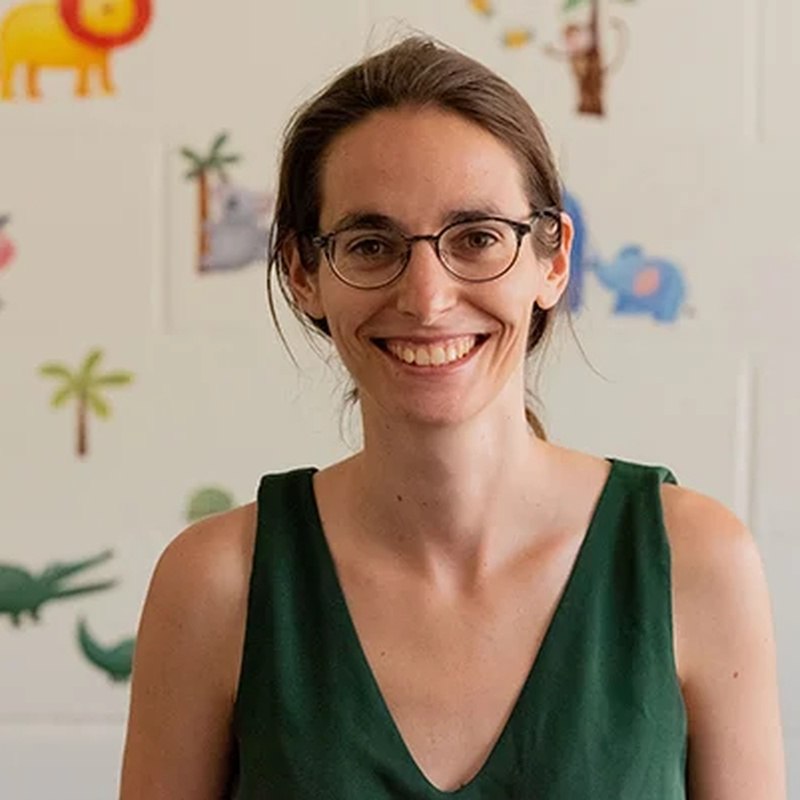
Laurie Bayet, PhD
2024 Toffler Scholar | Assistant Professor of Psychology, American University
Biography
Laurie Bayet’s scientific curiosity took shape early and expansively. As a child growing up in southwestern France, she felt drawn to understanding the natural world in all its forms. Her interests shifted constantly. When she learned about ancient civilizations, she imagined becoming an archaeologist.. For a time, animals captured her imagination, and she dreamed of becoming a zoologist.
What united these interests was curiosity rather than career ambition.
“I’ve always been curious about nature,” Bayet reflects, “including the social, human world.”
Biography
Laurie Bayet’s scientific curiosity took shape early and expansively. As a child growing up in southwestern France, she felt drawn to understanding the natural world in all its forms. Her interests shifted constantly. When she learned about ancient civilizations, she imagined becoming an archaeologist.. For a time, animals captured her imagination, and she dreamed of becoming a zoologist.
What united these interests was curiosity rather than career ambition.
“I’ve always been curious about nature,” Bayet reflects, “including the social, human world.”
She grew up near the Atlantic coast, between Bordeaux and La Rochelle, in an environment that encouraged exploration and reflection. As a teenager, she later moved to Toulouse, a city known for its academic institutions and scientific culture. Throughout these transitions, her curiosity never narrowed. Instead, it became more focused.
Research Focus
During high school, Bayet’s interests began to coalesce around a central question: how does the mind emerge from the brain?
At the time, the French school system offered limited formal education in psychology. Bayet encountered the brain through biology courses and explored questions of the mind through philosophy, including early exposure to psychoanalytic thought in philosophy class. Without a formal pathway, she pursued these questions independently, reading widely and designing an independent reading project that bridged biology and psychology.
It was only later that she learned this intersection had a name: cognitive science. While studying biology as an undergraduate, Bayet noticed a poster advertising a cognitive science forum. The realization that her interests aligned with a recognized field proved clarifying.
“It felt like discovering that something I had been thinking about already existed,” she says.
Bayet continued her training through France’s rigorous academic system, completing intensive preparatory coursework before entering the École Normale Supérieure. There, she completed her undergraduate degree in biology and pursued a master’s degree in cognitive science. This dual training allowed her to maintain a firm grounding in biological systems while exploring questions of perception, cognition, and development.
As a graduate student, Bayet’s interests shifted toward development. A course on genetics and cognitive development introduced her to the idea that understanding the adult mind requires understanding how it forms. She became fascinated by early life, when brain systems remain highly plastic and still organize themselves in response to experience.
“To understand how the mind works,” she explains, “you have to understand how it’s built.”
Bayet pursued doctoral training in developmental psychology, focusing on how infants process and interpret social information. Her PhD research examined how babies perceive facial
expressions, such as whether infants are better at detecting “fearful” (gasp) faces.
Following her doctorate, Bayet moved to the United States for postdoctoral training, holding a joint appointment at the University of Rochester, Boston Children’s Hospital, and Harvard Medical School. There, she expanded her methodological toolkit and contributed to projects investigating how infants’ brains represent visual objects and respond to facial expressions.
Her research contributes to ongoing debates about the nature of visual development.”
These insights now shape the core of Bayet’s independent research program at American University.
"To understand how the mind works. You have to understand how it’s built.”
- Laurie Bayet, PhD
Bayet’s research on how the infant brain processes social information aims to underscore the importance of early development, encouraging the audience to see its relevance for future interventions and understanding.
Her work employs neuroimaging, behavioral assessments, and computational modeling to explore how infants process facial movements, social cues, and emotional contexts, offering insight into the methods that underlie her findings.
If successful, these findings would have important implications for early intervention strategies, suggesting that targeting fundamental perceptual and cognitive processes could be more effective than focusing solely on “pattern matching” recognition of static facial emotions.
Her research is longitudinal, following infants from 5-8 months through the first year and a half of life. By linking early brain responses to later behavioral measures, she seeks to identify early markers that may signal the need for additional support before clinical symptoms emerge.
The Toffler Scholar Award supports this work at a critical juncture. The funding allows Bayet to expand sample sizes, enhance neuroimaging capabilities, and pursue high-risk questions that traditional funding mechanisms often overlook. It also enables her to examine development trans-diagnostically, focusing on shared cognitive processes rather than rigid diagnostic categories.
She emphasizes persistence, curiosity, and openness as essential skills, fostering the audience's respect and motivation for scientific perseverance and growth. “A big part of doing science is showing up,” she says. “The rest comes from luck, following curiosity, and staying with difficult questions.”
Looking ahead, Bayet aims to establish a research program that deepens understanding of how early brain development provides a foundation for lifelong learning and cognition. She hopes her work will ultimately inform earlier, more precise support strategies for children at risk, while also contributing fundamental insight into how humans learn to interpret the social world.
For Bayet, science remains an act of connection. It links biology and behavior, infancy and adulthood, research and lived experience. Above all, it reflects a commitment to understanding how minds grow and how early learning can shape futures.